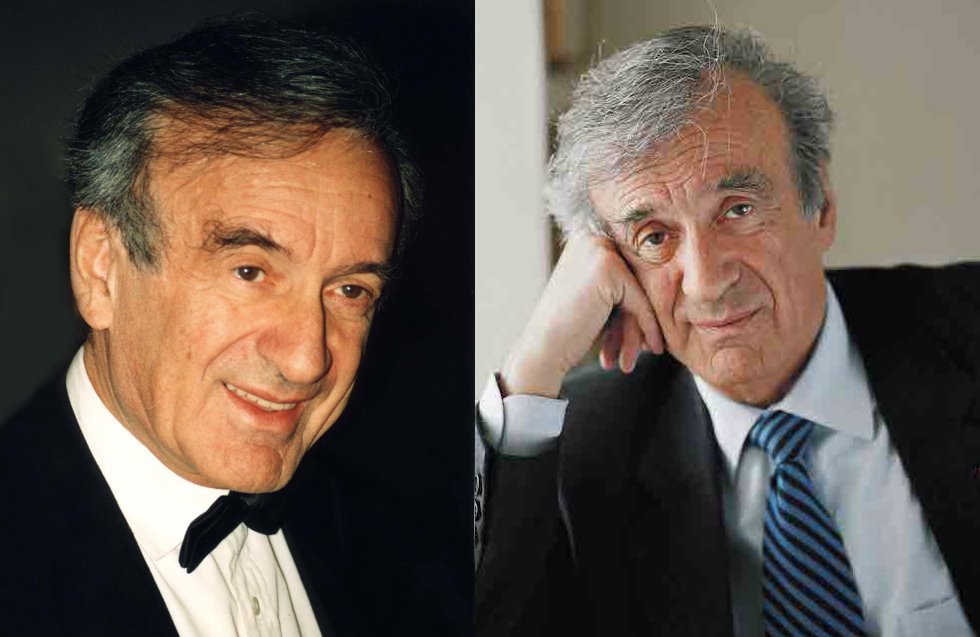
Elie Wiesel biography – Holocaust survivor, Nobel laureate, author of Night. Learn about his age, wife Marion, son Elisha, books, awards, and enduring legacy of human rights advocacy.
Who is Elie Wiesel?
Elie Wiesel stands as one of the most influential voices of the 20th century, transforming personal tragedy into a universal message of peace, human dignity, and the imperative to combat indifference. Born Eliezer Wiesel on September 30, 1928, in Sighet, Romania (then part of Transylvania), he survived the horrors of Nazi concentration camps to become a Nobel Peace Prize laureate, acclaimed author, and tireless human rights advocate.
Best known for his memoir “Night,” which chronicles his experiences in Auschwitz and Buchenwald, Wiesel dedicated his life to ensuring the world never forgets the Holocaust. His profound statement “The opposite of love is not hate, but indifference” became a rallying cry for human rights movements globally. Through more than 57 books, countless lectures, and decades of activism, he bore witness to humanity’s darkest hour while championing hope and dignity for oppressed peoples everywhere.
Wiesel passed away on July 2, 2016, at age 87 at his Manhattan home, leaving behind an extraordinary legacy. His wife Marion and son Elisha continue his mission through the Elie Wiesel Foundation for Humanity, ensuring his message resonates with future generations.
Quick Facts About Elie Wiesel
| Category | Details |
|---|---|
| Full Name | Eliezer Wiesel |
| Born | September 30, 1928 |
| Died | July 2, 2016 (aged 87) |
| Birthplace | Sighet, Romania (Transylvania) |
| Wife | Marion Erster Rose Wiesel (m. 1969-2016) |
| Children | Shlomo Elisha Wiesel (born 1972) |
| Parents | Shlomo Wiesel (father), Sarah Feig Wiesel (mother) |
| Siblings | Hilda, Beatrice (survived), Tzipora (died at Auschwitz) |
| Famous Work | Night (memoir, 1958/1960) |
| Major Award | Nobel Peace Prize (1986) |
| Nationality | Romanian-born, American citizen (1963) |
| Occupation | Writer, Professor, Human Rights Activist |
| Teaching Post | Boston University (1976-2016) |
Early Life in Sighet
Elie Wiesel grew up in the small Hasidic Jewish community of Sighet, situated in the Carpathian Mountains. His father, Shlomo Wiesel, owned a grocery store and instilled humanistic values in young Eliezer, encouraging him to learn Hebrew and read literature. His mother, Sarah, daughter of Dodye Feig—a Vizhnitz Hasid and farmer—emphasized religious devotion and mystical Jewish teachings.
The Wiesel family spoke multiple languages at home: Yiddish primarily, alongside German, Hungarian, and Romanian, reflecting the region’s complex cultural landscape. From age three, Elie attended Jewish school, where he studied Hebrew, Bible, and eventually Talmud. His maternal grandfather’s Hasidic influence and conversations with Moshe, a synagogue caretaker who taught him about the Messiah and Jewish mysteries, shaped his early spiritual worldview.
Wiesel described his childhood as a hermetic existence of prayer and contemplation. He displayed precocious devotion to religious study, even running to city hall to compose Bible commentaries on the town’s only Hebrew typewriter. His sheltered, pious upbringing made the coming devastation all the more shattering.
The Holocaust: From Darkness to Survival
Deportation and Auschwitz
In 1940, Hungary annexed Sighet, bringing the town under the control of Germany’s Nazi ally. Though life initially continued, everything changed when German forces invaded Hungary in March 1944. Within days, Jewish identity was “defined,” property confiscated, and by April, Jews were forced into ghettos. On May 15, 1944, deportations began.
Fifteen-year-old Elie, along with his parents and three sisters (Hilda, Beatrice, and Tzipora), were packed into cattle cars with thousands of other Sighet Jews and transported to Auschwitz-Birkenau. Upon arrival, his mother Sarah and youngest sister Tzipora were immediately murdered in the gas chambers. This night of arrival became the subject of his most famous passage: “Never shall I forget that night, the first night in camp, that turned my life into one long night seven times sealed.”
Buna-Monowitz and Father-Son Bond
Elie and his father Shlomo were selected for forced labour and sent to Buna-Monowitz, a sub-camp of Auschwitz III. There, they endured deplorable conditions—starvation, brutal cold, beatings, torture, and constant exposure to death. The bond between father and son became both source of strength and agonizing burden as each struggled to protect the other amid systematic dehumanization.
Death March to Buchenwald
In January 1945, as Soviet forces approached, Nazi guards forced prisoners on a death march to Buchenwald concentration camp. Weakened by months of deprivation, Wiesel’s father contracted dysentery. On January 28, 1945—just months before liberation—Shlomo Wiesel died after being beaten by a German soldier. Seventeen-year-old Elie witnessed his father’s death, powerless to help.
On April 11, 1945, American forces liberated Buchenwald. Elie Wiesel survived, but he emerged profoundly changed. He later learned his older sisters Hilda and Beatrice had also survived. The 10,154 Jews who lived in Sighet in 1930 had been reduced to fewer than 35 just years after the war.
Post-War Life and Education
After liberation, Wiesel spent time in a French orphanage for Jewish children. He moved to Paris and studied at the Sorbonne from 1948 to 1951, focusing on philosophy, literature, and psychology. During these years, he worked as a journalist for French and Israeli newspapers, traveling to Israel to cover the new nation’s establishment.
For ten years, Wiesel remained silent about his Holocaust experiences. This silence was deliberate—he sought to find proper words worthy of the testimony he would eventually bear. His breakthrough came through friendship with French Nobel laureate François Mauriac, who encouraged him to write his story.
Literary Career and “Night”
The Birth of a Classic
Wiesel’s first account of the Holocaust was published in Yiddish by an Argentinian press in 1955 as “Un di velt hot geshvign” (And the World Remained Silent), running about 800 pages. He condensed this into a 127-page French manuscript titled “La Nuit,” published in 1958, which was translated into English as “Night” in 1960.
One critic predicted Wiesel would be “a one-book writer,” but this memoir became foundational Holocaust literature, translated into more than 30 languages. Wiesel later said, “If I had not written Night, I would not have written anything else.” In 2006, Oprah Winfrey selected “Night” for her book club, introducing it to millions more readers.
Prolific Author
Wiesel ultimately wrote more than 57 books across multiple genres: novels, plays, essays, biblical commentary, and works on Jewish folklore. Major works include:
- Dawn (1961) – Story of a Holocaust survivor in pre-independence Israel
- The Accident/Le Jour (1962) – Exploration of survival and death
- The Town Beyond the Wall (1963) – Won Prix Rivarol and National Jewish Book Award
- A Beggar in Jerusalem (1968) – Won Prix Médicis
- Souls on Fire (1972) – Hasidic legends
- The Testament (1980) – Won Prix Livre Inter
- The Fifth Son (1983) – Won Grand Prize in Literature from Paris
- All Rivers Run to the Sea (1995) – First volume of memoirs
- And the Sea Is Never Full (2000) – Second memoir volume
His later novels included “A Mad Desire to Dance” (2009) and “The Sonderberg Case” (2010). He also wrote plays like “Zalmen or the Madness of God” and “The Trial of God.”
Academic Career
Wiesel became an American citizen in 1963 and embarked on a distinguished academic career. He served as Distinguished Professor of Judaic Studies at City University of New York (1972-1976) and became the first Henry Luce Visiting Scholar in Humanities and Social Thought at Yale University (1982-1983).
From 1976 until his death, Wiesel was the Andrew W. Mellon Professor in the Humanities at Boston University, where he also held the title of University Professor. Boston University created the Elie Wiesel Center for Jewish Studies in his honor. Remarkably, he never taught the same course twice during his 40-year tenure, creating continuous intellectual exchange with students who returned year after year.
Marriage and Family
In 1969, Wiesel married Marion Erster Rose, an Austrian-born writer, editor, and Holocaust survivor. Marion had fled Vienna with her parents during World War II, finding refuge in Belgium, France, and ultimately Switzerland before immigrating to the United States with help from the Hebrew Immigrant Aid Society (HIAS).
Marion became Elie’s collaborator, translating 14 of his books from French to English, including the new edition of “Night.” She also produced television programs and documentaries, including “A Passover Haggadah,” “The World of Elie Wiesel,” and “Children of the Night.”
In 1972, they welcomed their only child, Shlomo Elisha Wiesel, named after Elie’s father. Elisha grew up on Manhattan’s Upper West Side and Upper East Side, attending Ramaz School. He graduated from Yale University with a B.S. in computer science in 1994 and had a 25-year career at Goldman Sachs, rising to Chief Information Officer. Currently, he chairs the Elie Wiesel Foundation for Humanity board, working to “reboot” his father’s legacy.
Marion Wiesel passed away on February 2, 2025, at age 94, nearly nine years after her husband’s death.
Human Rights Activism
Presidential Commission and Holocaust Museum
In 1978, President Jimmy Carter appointed Wiesel chairman of the President’s Commission on the Holocaust (later renamed the U.S. Holocaust Memorial Council). He served from 1978 to 1986, spearheading the creation of the United States Holocaust Memorial Museum in Washington, D.C., which opened in 1993. The museum gives the Elie Wiesel Award to individuals advancing its vision of confronting hatred and promoting human dignity.
Universal Advocacy
Though rooted in Jewish suffering, Wiesel’s advocacy extended to oppressed peoples worldwide. He championed Soviet Jews, Nicaragua’s Miskito Indians, Argentina’s “disappeared,” Cambodian refugees, Kurdish people, South African apartheid victims, African famine victims, and victims in the former Yugoslavia and Darfur.
Elie Wiesel Foundation for Humanity
In 1986, shortly after receiving the Nobel Prize, Elie and Marion established the Elie Wiesel Foundation for Humanity to “combat indifference, intolerance and injustice.” Marion initiated creation of Beit Tzipora Centers in Israel, providing academic support and enrichment for Ethiopian-Israeli children.
Tragically, the Foundation lost $15 million of its endowment in Bernard Madoff’s Ponzi scheme, along with much of the Wiesels’ personal savings.
Awards and Recognition
Wiesel received more than 100 honorary degrees and numerous prestigious awards:
- Nobel Peace Prize (1986) – For being “a messenger to mankind” promoting peace, atonement, and dignity
- Presidential Medal of Freedom – America’s highest civilian honor
- Congressional Gold Medal (1985)
- Medal of Liberty Award (1986)
- Grand-Croix of the French Legion of Honor – France’s highest decoration
- National Humanities Medal
- Dayton Literary Peace Prize Lifetime Achievement Award (2007)
The Nobel Committee praised him as “one of the most important spiritual leaders and guides in an age when violence, repression, and racism continue to characterize the world.”
Death and Legacy
Elie Wiesel died at his Manhattan home on July 2, 2016. A private funeral service was held at Fifth Avenue Synagogue, followed by burial at Sharon Gardens Cemetery in Valhalla, New York. Utah Senator Orrin Hatch eulogized: “With Elie’s passing, we have lost a beacon of humanity and hope. We have lost a hero of human rights and a luminary of Holocaust literature.”
President Barack Obama called him “a great moral voice of our time and a conscience for our world.” In 2018, antisemitic graffiti was found on his birthplace in Sighet—a painful reminder that the hatred he fought remains present.
Today, his childhood home operates as the Elie Wiesel Memorial House and Museum of Jewish Culture in Sighetu Marmației, Romania, commemorating both his life and the destroyed Jewish community. His son Elisha continues his work, speaking at the U.S. Holocaust Memorial Museum and Auschwitz, and managing his father’s foundation and archives.
FAQs About Elie Wiesel
1. How old was Elie Wiesel when he died?
Elie Wiesel was 87 years old when he passed away on July 2, 2016, at his home in Manhattan, New York.
2. What is Elie Wiesel’s most famous book?
His memoir “Night” is his most famous and influential work, chronicling his experiences as a teenager in Nazi concentration camps at Auschwitz and Buchenwald.
3. Who was Elie Wiesel’s wife?
He married Marion Erster Rose in 1969, an Austrian-born Holocaust survivor, writer, and translator who worked closely with him throughout their marriage until his death in 2016.
4. Did Elie Wiesel have children?
Yes, Elie and Marion had one son, Shlomo Elisha Wiesel, born in 1972 and named after Elie’s father who died at Buchenwald.
5. Why did Elie Wiesel win the Nobel Peace Prize?
He received the 1986 Nobel Peace Prize for being “a messenger to mankind” whose message of peace, atonement, and human dignity grew from his Holocaust experiences into universal advocacy against violence, oppression, and indifference.
6. Where did Elie Wiesel teach?
He taught at Boston University from 1976 until his death as the Andrew W. Mellon Professor in the Humanities, where he also held the title of University Professor and never taught the same course twice.