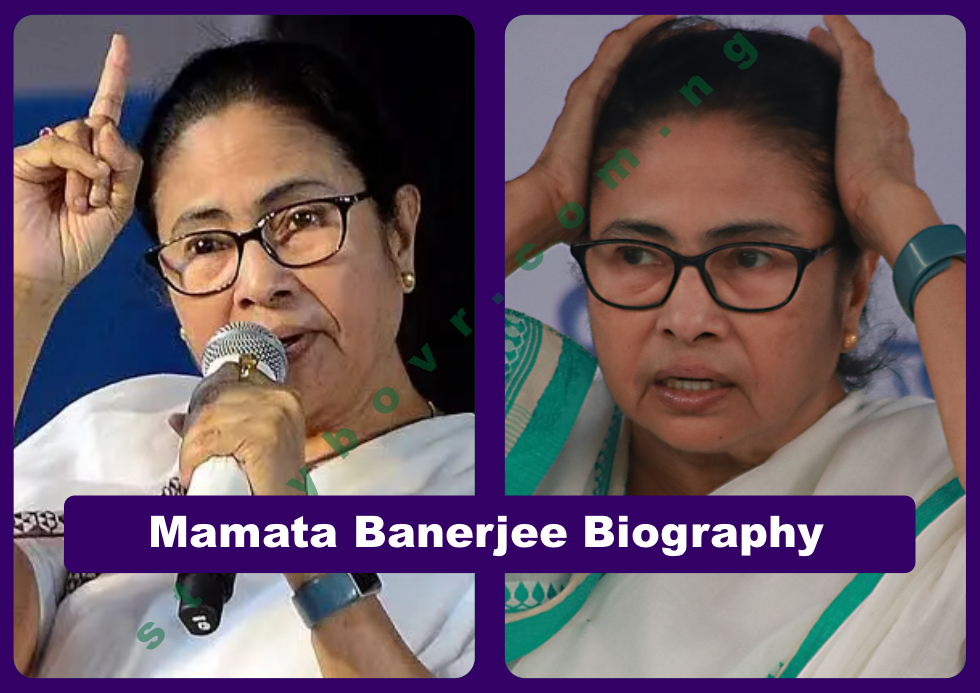
Explore Mamata Banerjee’s inspiring journey from grassroots activist to West Bengal’s first woman Chief Minister. Discover her achievements, challenges & impact.
Mamata Banerjee stands as one of India’s most formidable political figures—a woman who single-handedly dismantled 34 years of communist rule in West Bengal through sheer determination and grassroots connection. Born on January 5, 1955, in Kolkata, she is currently serving as the Chief Minister of West Bengal since 2011, making history as the first woman to hold this position. Affectionately called “Didi” (elder sister) by millions, Banerjee founded the All India Trinamool Congress in 1998 and transformed West Bengal’s political landscape forever.
What strikes me about Mamata Banerjee’s story is the raw authenticity of her political journey. In an era where politicians often lose touch with common people once they attain power, she remains identifiable by her trademark white cotton sari with blue border, rubber slippers, and a simple jhola (cloth bag). Watching her political career unfold over the decades reminds us that genuine commitment to public welfare, combined with unwavering courage, can indeed challenge even the most entrenched power structures. Her rise from a young Congress activist to becoming one of India’s most powerful regional leaders demonstrates that determination and people-centric politics can triumph over established political machinery.
Key Details Of Mamata Banerjee Biography
| Field | Information |
|---|---|
| Full Name | Mamata Banerjee |
| Date of Birth | January 5, 1955 |
| Age | 70 years (as of 2026) |
| Birthplace | Kolkata (formerly Calcutta), West Bengal |
| Parents | Promileswar Banerjee (Father – Freedom Fighter), Gayatri Devi (Mother – School Teacher) |
| Nationality | Indian |
| Political Party | All India Trinamool Congress (Founder & Chairperson) |
| Current Position | Chief Minister of West Bengal (Since 2011) |
| Education | BA (History), MA (Islamic History), B.Ed, LLB |
| Marital Status | Unmarried |
| Net Worth | Approximately ₹15-16 lakh (among India’s “poorest” CMs) |
| Known For | First woman CM of West Bengal, Railway Minister (twice), ending Left Front rule |
| Political Slogan | “Maa, Maati, Manush” (Mother, Land, People) |
| Nickname | Didi (Elder Sister) |
Early Life and Background
Mamata Banerjee was born into a lower-middle-class Bengali Brahmin family in south Kolkata. Her father, Promileswar Banerjee, was a freedom fighter who followed Gandhian principles, deeply influencing young Mamata’s ideological framework and commitment to social justice. Her mother, Gayatri Devi, worked as a school teacher and became the family’s pillar of strength after Promileswar’s untimely death when Mamata was still young.
Growing up in challenging economic circumstances following her father’s death, Mamata witnessed firsthand the struggles of ordinary people. These formative experiences shaped her political consciousness and instilled in her a deep empathy for the marginalized sections of society. Despite financial constraints, she remained determined to pursue education and build a life of purpose.
Education and Academic Journey
Mamata Banerjee’s educational journey reflects her intellectual curiosity and determination. She completed her higher secondary education from Deshbandhu Sishu Sikshalay in 1970. She then enrolled at Jogamaya Devi College, where she earned a Bachelor’s degree in History while simultaneously becoming involved in student politics.
Her academic pursuits continued with a Master’s degree in Islamic History from the University of Calcutta, which she completed in 1977 (examination held in 1979). She also obtained a Bachelor of Education degree from Shri Shikshayatan College and a law degree (LLB) from Jogesh Chandra Chaudhuri Law College, Kolkata, in 1982.
Interestingly, in 1984, Mamata briefly prefixed her name with ‘Dr,’ claiming to have completed a doctorate. However, when it came to light that the purported university (University of East Georgia) did not exist, she stopped using the title. This incident, while controversial, demonstrated her willingness to acknowledge errors—a rare quality in politics.
Political Journey: From Congress Activist to TMC Supremo
Early Political Awakening (1970s-1980s)
Mamata Banerjee’s political journey began remarkably early—at age 15, while still a student at Jogamaya Devi College. She established Chhatra Parishad Unions, the student wing of the Congress Party, defeating the well-entrenched All India Democratic Students Organisation affiliated with the Communist parties.
During the 1970s, she rapidly climbed the political ladder, serving as General Secretary of West Bengal Mahila Congress from 1976 to 1980, and General Secretary of West Bengal Congress from 1979 to 1980. Her fiery speeches and passionate activism quickly garnered attention.
Historic Parliamentary Victory (1984)
The year 1984 marked a watershed moment in Mamata’s career. In the Lok Sabha elections held following Prime Minister Indira Gandhi’s assassination, the young 29-year-old Mamata achieved the impossible—defeating veteran communist stalwart Barrister Somnath Chatterjee in the Jadavpur constituency, considered a Left Front citadel. She became the youngest woman ever elected to the Lok Sabha, stunning political observers across the country.
Union Cabinet Minister
Mamata Banerjee served in various ministerial positions in the Union Cabinet, including Minister of State for Human Resource Development, Youth Affairs and Sports, and Women and Child Development. Most notably, she served twice as Railway Minister—in 1999-2000 and again in 2009-2011—becoming the first woman to hold this prestigious portfolio.
Breaking from Congress: Birth of Trinamool Congress (1998)
By the late 1990s, Mamata grew increasingly disillusioned with the Congress Party’s leadership and its inability to challenge the Left Front’s dominance in West Bengal. In 1997-1998, she made the bold decision to break away and founded the All India Trinamool Congress (AITC or TMC). The word “Trinamool” means “grassroots,” reflecting her commitment to bottom-up politics.
This was an audacious move—breaking from a national party to form a regional one required immense courage and political acumen. Many predicted the TMC would fade into obscurity, but Mamata proved them spectacularly wrong.
The 2011 Revolution: Ending 34 Years of Communist Rule
The Singur-Tata Controversy: Catalyst for Change
Mamata Banerjee’s political resurrection came through her fierce opposition to the Left Front government’s land acquisition policies. In December 2006, she led a protest against the proposed Tata Nano plant in Singur, where the government had acquired farmland, displacing farmers.
She undertook a historic 25-day hunger strike, which became a turning point in West Bengal politics. The movement forced Tata Motors to relocate the plant to Gujarat and positioned Mamata as the voice of the dispossessed. This issue catalyzed her political comeback from near obscurity.
Historic 2011 Victory
In the 2011 West Bengal Legislative Assembly elections, Mamata Banerjee led the TMC-Congress alliance to a landslide victory, winning more than three-fifths of the seats. The victory ended the world’s longest-serving democratically elected communist government—the Left Front had ruled uninterrupted since 1977.
On May 20, 2011, Mamata Banerjee was sworn in as Chief Minister, becoming the first woman to hold this position in West Bengal’s history. The moment marked a seismic shift in Indian politics.
Chief Minister of West Bengal: Three Consecutive Terms
First Term (2011-2016): Breaking New Ground
Mamata’s first term focused on undoing what she perceived as the damage caused by 34 years of Left rule. Key initiatives included:
- Returning 400 acres of land to farmers caught in the Singur land acquisition dispute
- Launching the Kanyashree Prakalpa scheme to prevent child marriage and promote girls’ education, which won international recognition
- Introducing the Sabooj Sathi bicycle distribution scheme for students
- Implementing the Khadya Sathi food security scheme
In February 2012, the Bill & Melinda Gates Foundation praised her government for achieving a full year without reported polio cases.
Second Term (2016-2021): Consolidating Power
Mamata was re-elected in 2016 with an even larger majority, consolidating her position as a dominant regional leader. During this term, she continued expanding social welfare schemes and infrastructure development.
Third Term (2021-Present): Victory Amid Challenges
The 2021 assembly elections were fiercely contested, with several TMC leaders defecting to the BJP. Despite losing her own Nandigram constituency to BJP’s Suvendu Adhikari by 1,956 votes, Mamata led her party to a massive victory, winning 213 of 292 seats.
She later won the Bhabanipur by-election by a commanding margin of 58,835 votes and was sworn in as MLA on October 7, 2021. Key initiatives during this term include the Lakshmir Bhandar scheme, providing basic financial assistance to women.
Major Achievements and Welfare Schemes
Kanyashree Prakalpa: This groundbreaking scheme provides annual scholarships and one-time grants to girls from economically disadvantaged families to prevent child marriage and promote education. The UN awarded India first place in the Asia-Pacific group for this initiative.
Lakshmir Bhandar: Launched post-2021 elections, this scheme provides ₹500-1,000 monthly to women under age 60, offering crucial financial support to millions.
Sabooj Sathi: Distribution of bicycles to approximately 40 lakh students in classes 9 and 11 studying in government schools.
Khadya Sathi: Food security scheme providing subsidized rice and wheat to over 7.5 crore people (82% of the state’s population).
Swasthya Sathi: Universal health insurance scheme ensuring medical coverage for families.
Shramashree Scheme (2025): Rehabilitation initiative for Bengali-speaking migrant workers, providing travel grants, monthly allowances, ration cards, and health insurance.
Creative Pursuits: Poet and Painter
Beyond politics, Mamata Banerjee is an accomplished poet and self-taught painter. She has authored numerous books, with her poetry reflecting her multifaceted identity and cultural heritage. In 2022, she received the Paschimbanga Akademy Award for “Kabita Bitan,” a collection of 946 poems.
Her paintings have been auctioned several times, with proceeds dedicated to developmental and social causes. One painting, “Flower Power,” sold for $3,000 in New York in 2012. However, controversies arose when one of her paintings was sold to Sudipto Sen (central figure in the Saradha scam) for ₹1.8 crore.
Controversies and Challenges
Saradha and Rose Valley Scams: Financial scandals involving Ponzi schemes that emerged during her tenure, with several TMC legislators questioned. The sale of her paintings to scam-accused individuals came under scrutiny.
RG Kar Medical College Incident (2024): Mamata faced severe criticism over the alleged cover-up of a trainee doctor’s rape and murder, with accusations of protecting the institution’s principal. Widespread protests demanded her resignation.
Sandeshkhali Allegations (2024): Women in Sandeshkhali village accused TMC leader Sheikh Shahjahan and associates of sexual assault. Mamata was criticized for allegedly remaining silent and protecting criminal politicians.
I-PAC Raids (January 2026): The Enforcement Directorate alleged that Mamata removed documents and electronic devices during searches at political consultancy I-PAC’s offices, which she and TMC denied, calling it politically motivated.
Voter List Controversy (2025-2026): Mamata has been actively opposing the Election Commission’s Special Intensive Revision exercise, claiming it unfairly targets citizens and is a hidden attempt to implement NRC.
Personal Life and Character
Mamata Banerjee has remained unmarried throughout her life, dedicating herself entirely to public service. She is known for her austere lifestyle—living simply, wearing traditional white cotton saris with blue borders, rubber slippers, and carrying a simple cloth bag.
Despite being entitled to a monthly salary of approximately ₹2 lakh as Chief Minister, she has not claimed her salary since taking oath in 2011. Her primary sources of income are royalties from her books and paintings. With declared assets of just ₹15-16 lakh, she is among India’s “poorest” chief ministers—a stark contrast to the wealthiest CM whose assets exceed ₹510 crore.
Impact and Legacy
Mamata Banerjee’s legacy is deeply complex and multifaceted. She successfully dismantled one of the world’s longest-serving communist governments through democratic means—a feat few thought possible. Her pro-woman initiatives like Kanyashree have received international acclaim and transformed countless lives.
Her political style combines fiery rhetoric with genuine grassroots connection. While critics accuse her of authoritarianism and protecting corrupt allies, supporters see a leader who has remained accessible to ordinary people despite wielding immense power.
Her “Maa, Maati, Manush” (Mother, Land, People) slogan captures her political philosophy—prioritizing land rights, cultural identity, and welfare of common people. Whether loved or criticized, Mamata Banerjee has undeniably left an indelible mark on West Bengal and Indian politics.
Conclusion
Mamata Banerjee’s political journey is a testament to resilience, conviction, and the power of grassroots politics. From a young activist challenging communist dominance in the 1980s to becoming one of India’s most influential regional leaders, her story embodies the possibilities inherent in Indian democracy.
What makes her remarkable is not just electoral success but the authenticity she has maintained—the same white sari, the same simple lifestyle, the same accessibility to common people. In an era of dynastic politics and imported ideologies, she represents homegrown, people-centric leadership.
Her legacy will be debated for generations—critics will point to controversies and authoritarian tendencies, while supporters will celebrate her welfare schemes and commitment to the marginalized. But regardless of one’s political stance, Mamata Banerjee’s impact on West Bengal politics is undeniable and transformative.
As she continues serving as Chief Minister in 2026, facing new challenges including voter list controversies and opposition pressure, one thing remains clear: “Didi” is a political force who has fundamentally altered the trajectory of West Bengal. Her story reminds us that in democracy, determination combined with genuine connection to people can indeed move mountains—or in her case, dismantle seemingly invincible political establishments.
Frequently Asked Questions
Who is Mamata Banerjee? Mamata Banerjee is an Indian politician serving as Chief Minister of West Bengal since 2011. She is the first woman to hold this position and is the founder and chairperson of the All India Trinamool Congress.
What is Mamata Banerjee known for? She is renowned for ending 34 years of communist rule in West Bengal, serving twice as India’s Railway Minister, launching pro-women welfare schemes, and her austere lifestyle and grassroots political approach.
What is Mamata Banerjee’s net worth? Her declared assets are approximately ₹15-16 lakh, making her one of India’s chief ministers with the lowest declared wealth. She does not claim her CM salary and lives very simply.
Is Mamata Banerjee married? No, Mamata Banerjee has remained unmarried throughout her life, dedicating herself entirely to public service and political work.
What are Mamata Banerjee’s biggest achievements? Her major achievements include becoming the first woman CM of West Bengal, ending Left Front’s 34-year rule, implementing transformative welfare schemes like Kanyashree and Lakshmir Bhandar, serving twice as Railway Minister, and winning three consecutive assembly elections with strong majorities.