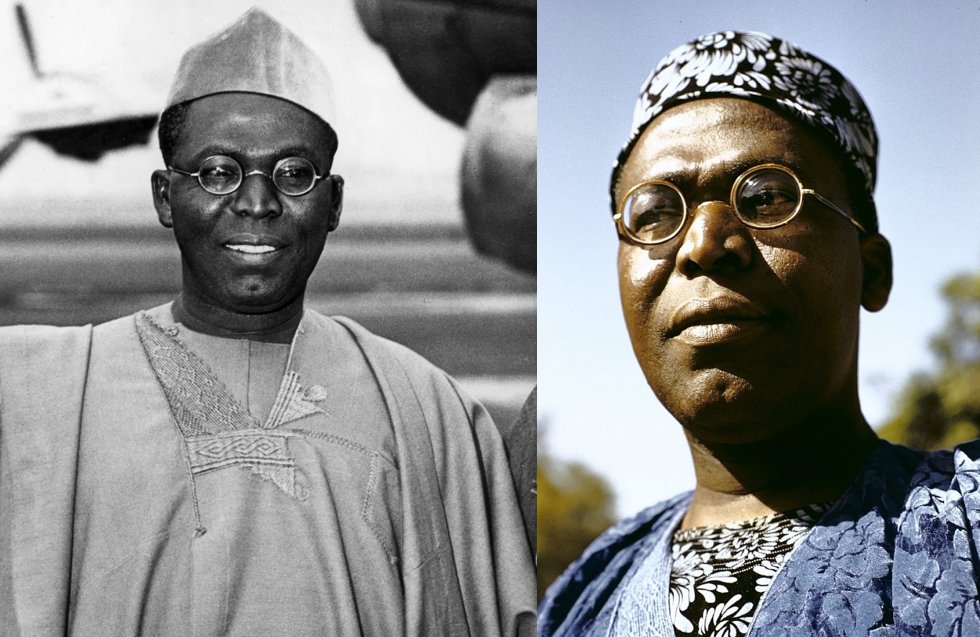
Obafemi Awolowo biography – Complete story of the legendary Nigerian statesman, his wife Hannah, five children, political career, achievements, death in 1987, and enduring legacy.
Who is Obafemi Awolowo?
Chief Jeremiah Obafemi Oyeniyi Awolowo stands among Nigeria’s most revered founding fathers and remains an iconic figure in the nation’s political history. Born on March 6, 1909, in Ikenne, Ogun State, he emerged as a formidable nationalist, statesman, and visionary leader who profoundly shaped Nigeria’s journey toward independence and democratic governance.
Widely known as “Awo” or “The Sage,” Obafemi Awolowo served as the first Premier of Western Nigeria from 1954 to 1959, where he implemented groundbreaking social welfare programs that transformed the region into a beacon of progress. His administration introduced free primary education, free healthcare for children, and established Africa’s first television station, setting standards that influenced governance across the continent.
Awolowo’s political philosophy centered on federalism, social democracy, and the empowerment of Nigeria’s diverse ethnic groups through education and infrastructure development. His writings, including “Path to Nigerian Freedom” and his autobiography “Awo,” articulated a vision for Nigeria that continues to inspire political discourse decades after his death on May 9, 1987, at age 78.
Quick Facts About Obafemi Awolowo
| Category | Details |
|---|---|
| Full Name | Jeremiah Obafemi Oyeniyi Awolowo |
| Nickname | Awo, The Sage, Asiwaju Awon Yoruba |
| Date of Birth | March 6, 1909 |
| Place of Birth | Ikenne, Ogun State, Nigeria |
| Date of Death | May 9, 1987 |
| Age at Death | 78 years |
| Wife | Hannah Idowu Dideolu Awolowo (married 1937) |
| Children | Five (Olusegun, Omotola, Oluwole, Ayodele, Tokunbo) |
| Father | David Shopolu Awolowo |
| Mother | Mary Efunyela Awolowo |
| Tribe | Yoruba (Remo) |
| Political Party | Action Group (AG), Unity Party of Nigeria (UPN) |
| Notable Position | Premier of Western Region (1954-1959) |
| Education | University of London (Bachelor of Commerce, Law degree) |
| Honor | GCFR – Grand Commander of the Federal Republic |
Early Life and Family Background
Obafemi Awolowo was born as the only son among his siblings to David Shopolu Awolowo, a farmer and sawyer, and Mary Efunyela Awolowo. His birth name, Obafemi, translates to “The king loves me” in Yoruba, while his surname Awolowo means “The mystic commands honour or respect,” names that would prove prophetic throughout his distinguished life.
His father came from a prominent lineage, born to a high chief and member of the Iwarefa, the leading faction of the traditional Osugbo group that ruled Ikenne. In 1896, David Awolowo became one of the first Ikenne natives to convert to Christianity, a decision that created tension with his family’s traditional beliefs. Young Obafemi’s paternal grandmother, Adefule Awolowo, remained a devout worshipper of Ifá and believed that her grandson was a reincarnation of her own father.
Tragedy struck when Obafemi was approximately eleven years old. His father died on April 8, 1920, from smallpox, ironically the same disease he had challenged as a Christian convert. This loss profoundly impacted young Awolowo, forcing him to become self-reliant and resourceful at an early age. Growing up in Ikenne town in the Remo division, he developed the resilience and determination that would characterize his later achievements.
Education and Academic Pursuits
Following his father’s death, Obafemi attended various mission schools including Baptist Boys’ High School (BBHS) in Abeokuta. Financial constraints forced him to work multiple jobs to finance his education. He became a teacher in Abeokuta and later qualified as a shorthand typist, subsequently serving as a clerk at Wesley College Ibadan and working as a correspondent for the Nigerian Times.
His entrepreneurial spirit manifested through various careers including money lending, taxi driving, and produce brokerage. These experiences provided practical knowledge about Nigerian society and economic systems that would later inform his political policies. In 1927, Awolowo enrolled at the University of London as an External Student, completing a Bachelor of Commerce degree in 1944 through correspondence courses while juggling multiple jobs in Nigeria.
His greatest ambition was studying law, which he pursued in London from 1944 to 1946. During this period in Britain, he immersed himself in political theory and wrote his first book, “Path to Nigerian Freedom,” which criticized British colonial policies and advocated for rapid self-governance. He was called to the Bar by the Honorable Society of the Inner Temple on November 19, 1946, returning to Nigeria in 1947 to establish a thriving legal practice in Ibadan.
Marriage and Family Life
On December 26, 1937, Obafemi Awolowo married Hannah Idowu Dideolu Adelana, beginning a partnership that would endure for fifty years until his death. Hannah, often called “HID Awolowo,” became not just his wife but his strongest ally, confidante, and political partner. Their marriage exemplified mutual respect, with Hannah playing crucial roles in supporting Awolowo’s political career and managing family affairs during his imprisonment.
The couple had five children: Olusegun Awolowo (1938-1963), Omotola Oyediran (née Awolowo) (1940-2020), Oluwole Awolowo (1942-2013), Ayodele Soyode (née Awolowo) (1944-2011), and Tokunbo Awolowo-Dosunmu (1948-present). Tragically, their eldest son Olusegun died in 1963 while Awolowo was imprisoned, a loss that devastated the family but also garnered widespread public sympathy.
Hannah proved herself an extraordinary woman, maintaining family unity during Awolowo’s numerous political battles and imprisonment. She lived to become a respected matriarch, surviving to her nineties and witnessing the passing of three of her children before her own death. Their daughter Ayodele Soyode became the mother of Dolapo Osinbajo, who served as Second Lady of Nigeria when her husband Yemi Osinbajo was Vice President.
Political Career and Achievements
Founding the Action Group
While studying in London in 1945, Awolowo founded Egbe Omo Oduduwa (Society of the Descendants of Oduduwa), a Yoruba cultural organization aimed at preserving Yoruba culture and promoting unity. Upon returning to Nigeria, he transformed this cultural movement into a powerful political force by establishing the Action Group (AG) in 1951, which became the dominant political party in Western Nigeria.
Premier of Western Region (1954-1959)
As Premier of the Western Region from 1954 to 1959, Awolowo implemented revolutionary policies that transformed the region into Nigeria’s most developed area. His administration introduced universal free primary education, making Western Nigeria the first region in Africa with such a program. Free healthcare was provided for children, dramatically reducing infant mortality rates and improving public health.
His government established Africa’s first television station in 1959, the Western Nigeria Television (WNTV), symbolizing his commitment to modernization and information access. He also founded the Nigerian Tribune newspaper in 1949, which became a powerful tool for nationalist consciousness and remains Nigeria’s oldest surviving private newspaper.
The Oduduwa Group, a conglomerate of businesses, was established to generate revenue for the region’s development programs. These initiatives were financed primarily through the lucrative cocoa industry, which Awolowo managed efficiently. His administration also constructed the first stadium in West Africa and developed the best civil service system in Africa at that time.
Opposition Leader and Imprisonment
Following Nigeria’s independence in 1960, Awolowo became Leader of the Opposition in the federal parliament. However, in 1963, he was controversially tried and convicted for allegedly conspiring to overthrow the government, receiving a ten-year prison sentence. Many historians and supporters viewed this trial as politically motivated, designed to eliminate a formidable opposition voice.
While imprisoned, Awolowo experienced profound personal tragedy when his beloved eldest son Olusegun died in 1963. This loss, combined with his unjust incarceration, generated widespread sympathy across Nigeria. During this period, he turned to spiritual reflection and wrote “Thoughts on the Nigerian Constitution” (1966), advocating for federal restructuring into multiple states.
Civil War Role and Finance Commissioner
The military coup of 1966 led to Awolowo’s release in July of that year. When the Nigerian Civil War erupted in 1967 following Biafra’s secession, Awolowo initially hesitated but eventually supported the federal government. He served as Federal Commissioner of Finance and Vice Chairman of the Federal Executive Council under General Yakubu Gowon’s military administration from 1967 to 1971.
During his tenure as Finance Commissioner, Awolowo coined the name “Naira” for Nigeria’s currency, replacing the Nigerian Pound. However, his role during the civil war attracted criticism from Igbo communities, who held him partially responsible for wartime suffering and the controversial economic policies that affected the Eastern Region.
Presidential Campaigns and Later Years
When Nigeria returned to civilian rule in 1979, Awolowo formed the Unity Party of Nigeria (UPN) and contested the presidency with explicitly socialist policies emphasizing education, healthcare, and economic justice. Despite strong showings, he lost both the 1979 and 1983 presidential elections amid controversial circumstances and allegations of electoral manipulation.
After the 1983 military coup, Awolowo retired from active politics but remained an influential elder statesman. He served as Chancellor of both the University of Ife (later renamed Obafemi Awolowo University) and Ahmadu Bello University. He was conferred with the title Grand Commander of the Federal Republic (GCFR) by President Shehu Shagari, becoming the first non-president to receive this honor.
Awards and Recognition
Throughout his lifetime, Obafemi Awolowo received numerous honors acknowledging his contributions to Nigeria’s development. Beyond the GCFR, he was recognized as a Senior Advocate of Nigeria (SAN), the highest legal rank for practicing lawyers. His leadership of the Yoruba people earned him the traditional title “Asiwaju Awon Yoruba” (Leader of the Yorubas).
After his death, the Federal Government renamed the University of Ife as Obafemi Awolowo University on May 12, 1987, three days after his passing. On October 1, 2010, during Nigeria’s golden jubilee celebrations in Abuja, the federal government posthumously honored Awolowo for his contributions to the independence movement.
The Obafemi Awolowo Foundation, established in 1992, continues promoting his ideals through scholarship programs, policy research, and annual events examining contemporary issues through the lens of Awolowo’s philosophy. His image appears on Nigerian currency, and numerous institutions, roads, and facilities across Nigeria bear his name.
Death and Funeral
Chief Obafemi Awolowo died on May 9, 1987, at his hometown Ikenne in Ogun State at age 78. His death sparked national mourning, with tributes pouring in from across Nigeria and the African continent. President Ibrahim Babangida declared a state funeral, and his body lay in state for an extended period as millions of Nigerians paid their respects.
His funeral became one of the largest gatherings in Nigerian history, with dignitaries from across Africa attending. The procession through Yoruba towns demonstrated the profound impact he had on his people. Hannah Awolowo, his widow, survived him by many years, becoming a revered matriarch before her own passing.
Legacy and Lasting Impact
Obafemi Awolowo’s legacy transcends his lifetime, continuing to influence Nigerian politics, education, and social policy. His philosophy of democratic socialism, federalism, and ethnic autonomy remains central to discussions about Nigeria’s political structure. Politicians across party lines invoke his name and principles, though interpretations of “Awoism” vary widely.
His emphasis on education as the foundation of development inspired generations of Nigerian leaders. The free education policy he implemented produced countless professionals who shaped Nigeria’s post-independence trajectory. His vision of a federal Nigeria composed of autonomous states based on ethnic-linguistic identities influenced the country’s evolution from three regions to the current 36 states.
Awolowo’s writings continue to be studied in universities, with his autobiography and political treatises remaining relevant to contemporary debates about governance, federalism, and social justice. His life story inspires Nigerians facing adversity, demonstrating how determination and integrity can overcome obstacles including poverty, imprisonment, and political persecution.
Interesting Facts About Obafemi Awolowo
Despite losing his father at age eleven, Awolowo’s self-reliance enabled him to finance his education through multiple jobs while maintaining academic excellence. His grandmother’s belief that he was a reincarnation of his great-grandfather influenced his spiritual worldview throughout life.
He established Africa’s first television station and built the first stadium in West Africa while premier, demonstrating his commitment to modernization and infrastructure. His coining of “Naira” as Nigeria’s currency name reflects his lasting influence on national identity.
Though he never won the presidency despite three attempts (1959, 1979, 1983), his impact on Nigerian politics exceeded many who held that office. His integrity was such that he was the first non-president honored with the GCFR, Nigeria’s highest national honor.
Frequently Asked Questions About Obafemi Awolowo
How old was Obafemi Awolowo when he died?
Obafemi Awolowo was 78 years old when he died on May 9, 1987, having been born on March 6, 1909.
Who was Obafemi Awolowo’s wife?
His wife was Hannah Idowu Dideolu Awolowo, whom he married on December 26, 1937, and they remained together until his death in 1987.
How many children did Obafemi Awolowo have?
Awolowo had five children: Olusegun (1938-1963), Omotola (1940-2020), Oluwole (1942-2013), Ayodele (1944-2011), and Tokunbo (born 1948).
What did Obafemi Awolowo do for Nigeria?
As Premier of Western Nigeria, he introduced free primary education, free healthcare for children, established Africa’s first TV station, built the region’s first stadium, and coined the name “Naira” for Nigeria’s currency.
Why is Obafemi Awolowo called “The Sage”?
He earned this title due to his wisdom, visionary leadership, intellectual depth, and philosophical approach to politics that emphasized long-term national development over short-term gains.
What happened to Obafemi Awolowo’s first son?
His eldest son, Olusegun Awolowo, died in 1963 at age 25 while his father was imprisoned, a tragedy that deeply affected the Awolowo family and generated nationwide sympathy.